By Horlane Mbayo
Source: khabarhub.com
While many AI solutions have originated in and stayed mainly a “developed” country phenomenon, they are increasingly becoming the answer to many challenges in the Global South, showing huge potential for helping to achieve sustainable development objectives globally. Technologies as simple as mobile phone apps are now using AI to predict human behaviours, making decisions at a faster, more cost-effective rate, and are relatively inexpensive solutions to some of the world’s biggest problems. It’s no surprise then that AI has become a major focus in international development discussions.
For example, healthcare sectors around the world are seeing immense advantages with the implementation of AI technologies. Tools such as Natural Language Processing (NLP) have allowed doctors in remote regions to be able to find the latest research quickly and more accurately, by retrieving and analyzing medical materials and assisting medical diagnoses. While the benefits are many, there are a lot of risks that come with the application of AI in a developmental context. In particular, there are questions around power and how the imbalance of power impacts the absorption of AI.
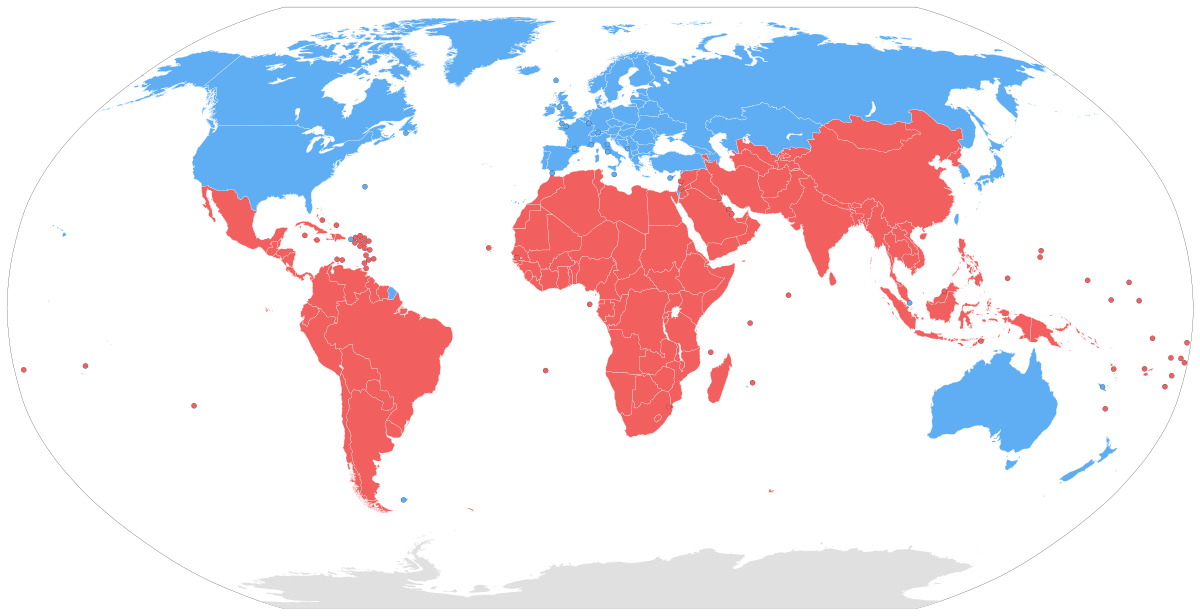
Power imbalance is a key theme in international development discourse, specifically a North-South imbalance. Donor governments and organizations have asymmetrical power relationships with the developing world, and this unbalanced relationship can affect the way knowledge is cultivated, shared, and information is accessed.
Power imbalances between high, medium, and low-income countries shape disparities in knowledge. Technologies, tools, and models developed for use in developing country contexts, should they continue to have data stored within the west, can only result in further reinforcing and heightening this imbalance of power. Ultimately, the development of AI technologies for but not by developing countries can only further amplify existing oppression and biases.
NLP
How do we deal with this issue of power imbalance in AI, in the context of international development? Take the example of Natural Language Processing (NLP). As put by Eleanor, a consultant at – IAIDL, “NLP is the field within AI that explores how humans and computers can interact in natural languages. Amazon’s Alexa or Apple’s Siri responding to a spoken instruction, Google Translate taking a sentence in one language and translating it into another, and YouTube’s auto-captioning program are all examples of NLP systems. NLP systems are able to take language and turn it into data – a language that a machine can understand.” Pretty cool right?
However, we have already written about how NLP models can amplify biases without the right data. This problem is even more acute in the development context, where power imbalances with regards to language are already an issue. Over half of the world’s population does not have access to knowledge and information because it’s not available in their language. 63% of Sub-Saharan Africans, for example, cannot access global markets due to language barriers. Thus, the existing power dynamic between the Global North and South is maintained as technologies capable of helping/speeding up development cannot serve foreign populations, others whose cultures are not rooted in Indo-European practices. And so, as with industry 1.0 and other technologies of times past, a digital divide is created
At the same time, NLP has a huge amount to offer for international development. Local/vernacular language translations are essential for an abundance of reasons, ranging from crisis management to sustainable trade. NLP tools could save lives through simple translation. Being able to use local/native languages within digital services automatically provides an array of possibilities for the citizens in the Global South to engage in this ever-expanding digital world. For example, many countries in the Global South are agrarian economies with smallholder farmers playing an important role. By creating tailor-made NLP tools for development, we can empower these farmers by allowing them to interact in their native tongues with the technology, allowing them access to a wide range of information, ultimately leading to an increase in production and implementation of better farming practices.
What are governments doing?
India offers an example of the challenges involved in building NLP tools that fit a local context, but at the same time shows how governments across the Global South might be successful in doing so. With its amalgamation of ethnic groups and various dialects – with 29 national languages spoken – only 10% of Indians speak English, showcasing a clear need to be able to build NLP based applications in vernacular languages.
The Indian government’s general strategy around AI has been to develop a sustainable AI ecosystem, focusing on social growth and inclusion. In terms of NLP specifically, in 2019, the Ministry of Electronics and IT proposed Natural Language Translation. The national mission on natural language translation was aimed to make science and technology accessible to all by facilitating access to teaching and researching material bilingually — in English and in one’s native Indian language. To achieve this, the government plans to leverage a combination of machine translation and human translation, overcoming the language barrier, with the help of public and private actors.
Furthermore, the government’s enthusiasm, support, and initiatives have provided a further push to foster the implementation of vernacular languages into AI systems. This traction has already motivated homegrown innovators and early adopters to develop solutions integrating Indian’s vast languages into systems being developed. For instance, over 40% of the healthcare startup Practo’s appointments and patient communication messages are in 11 Indian languages. And the government’s BHIM UPI app with over 25 million downloads is available in 13 Indian languages.
Gnani.ai is another great example, it solves the problem of speech recognition for Indian languages, allowing the next 300 Million Indians to embrace the digital world. At Gnani.ai, the creators build speech recognition engines for Indic languages. The bot can automatically understand the speech and language a person is talking in, and assist accordingly.
AI still operates in a field of unequal power, and whilst there’s still a lot to be understood, there are some countries showing clear signs of success in counteracting this inequality. Whilst that is hopeful, it is clear that there remains a need to continue modifying, and improving upon but the advantages AI-powered technologies can bring, make it a core tenet to inclusive development.
For this to occur, there is an argument to be made for a global system that can account for diversified perspectives as well as a distributed intelligence network that can adjust to new data, incorporate new models of thinking, and benefit from cultural diversity. A bottom-up approach, that includes the implementation and growth of new technologies at the grassroots level will allow for countries in the Global South to become participants in the AI revolution rather than just consumers, as India has shown us. Local innovators can be empowered by AI to leverage global resources as well as localise technological offerings to suit their domestic purposes, allowing them to have a knowledge advantage. For development programs, an understanding of local context, cultures, and languages will increase effective and efficient projects.
Should you decide that you’d like to delve deeper, we’ve provided a list of organisations, companies, and hubs, within ‘developing’ countries that are actively working to make NLP tools more contextual and inclusive:
-
Mozilla and the GIZ initiated a collaboration with African startups to develop Mozilla’s “Common Voice” and “Deep Speech” projects, which will provide voice-enabled products and services in African languages.
-
November 2019 the Artificial Intelligence for Development programme (AI4D) launched the start of the African Language Dataset Challenge, in collaboration with the data science challenge website Zindi, as part of another bid to bridge the gap between those languages with plenty of data available on the Internet and those without.
-
The AI4D-Africa Network runs the African Language Dataset Challenge. It is a network of excellence in AI in sub-Saharan Africa. It is aimed at strengthening and developing community, scientific and technological excellence in a range of AI-related areas.
-
“FAIR Forward – Artificial Intelligence for All” aims to improve the conditions for local artificial intelligence (AI) innovation to solve local problems in Rwanda, Uganda, Ghana, South Africa, and India. Besides engaging in local capacity development and supporting the development of AI policies and ethical AI guidelines, FAIR Forward works with its partners to improve the access to training data for natural language processing as well as AI and machine learning models.
-
Digital Umuganda – Rwanda based startup
-
Masakhane – a research movement for machine translation for African languages
-
Deep Learning Indaba – promotes AI in Africa and holds an annual conference
-
Data Science Africa – connects the continent’s researchers
-
BlackinAI, an initiative that promotes the inclusion of black people in the field of Artificial Intelligence
-
Nokwary Technologies – an AI-focused business based in Accra, Ghana.
-
Western and Central Africa Higher Education Centers of Excellence Project – is strengthening the capacities of participating African universities to deliver high-quality training and conduct applied research in areas such as data mining, with applications for ML.
-
Reverie, one of the first Indian technology-based languages localization company, helps companies build multilingual chatbots in Indian languages.
-
AI4Bharat, a platform to accelerate AI innovation in India
-
C-DAC’s Graphics and Intelligence-based Script Technology (GIST) lab and Technology Development for Indian Languages (TDIL) have led initiatives on creating language corpora, dictionaries, and tools.
-
IIT (Indian Institute of Technology) Mumbai has set up a Center for Indian Language Technology (CFILT) with a grant from the Department of Information Technology (DIT) to facilitate NLP research and development and has built Hindi, Marathi, and Sanskrit WordNet.
To conclude, there are a lot of actors working to minimise the language gap within AI. But more is required from governments in the Global South, to assist in cultivating and creating strategies that incorporate various languages and dialects. Ensuring that the technological tools being developed and used in their countries, are representative of the many and not just a few. It is imperative that governments take decisive action to be the main players in their countries’ AI development.