
By Tom Westgarth
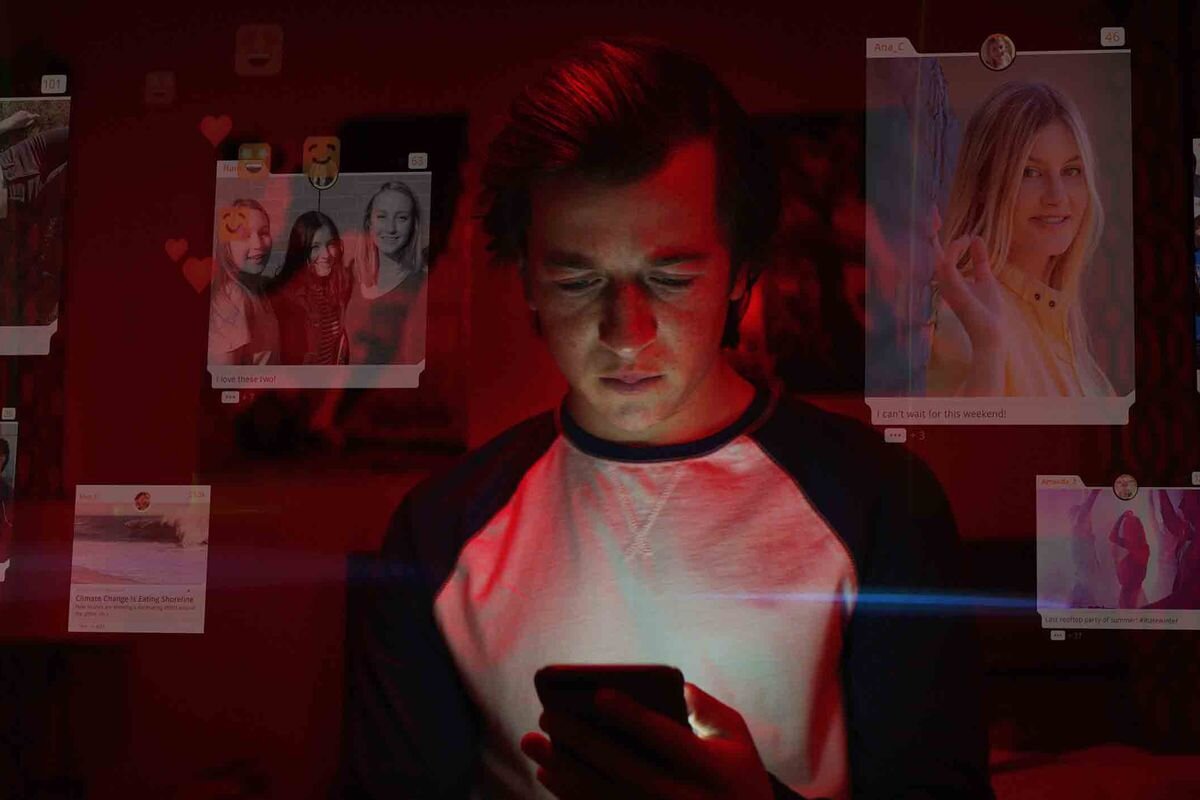
(The Social Dilemma – Netflix).
Although pointing to many of the problems gripping society, the Netflix film doesn’t provide an accurate understanding of the modern digital economy.
In his latest film, The Social Dilemma, writer and director Jeff Orlowski attempts to shine a light on many of the by-products of the internet age. Surveillance, misinformation, political polarisation, and mental health crises all feature as prominent themes throughout the show, with the documentary frequently returning to a dramatised family experiencing the fallout from an increasingly online life.
Whilst viewers may recoil in horror at the mechanisms by which social media clings onto your behavioural data, the film fails to articulate a coherent criticism of the modern digital economy. By selecting a poor range of guest interviewees and presenting a techno-deterministic view of the world, The Social Dilemma tells the story that many Silicon Valley members want you to hear.
The Attention Merchants
The docu-film certainly identifies many key features of the ‘attention economy’ well. For example, the concept of data colonialism; a predatory extracting model that relies on the aggregation of further data to increase profits, is parsed out excellently. This helps to understand the disturbing mechanisms by which we are often becoming inseparable from our screens.
Orlowski’s project brings together a series of former Big Tech executives, investors, and other activists to paint a picture of the modern digital economy. The eclectic mix (well, not in terms of gender or ethnicity) of software engineers describe how their creations span out of control.
We hear from Justin Rosenstein, the co-creator of Facebook’s infamous ‘Like Button’, who viewed it as a tool of positivity. But like much of the architecture constituting these companies, the feature purely drove engagement, leading to problems of addiction and polarisation down the line.
Ideas will be introduced, then played out in a fictionalised family, whose two youngest children are addicted to their smartphones. In these scenes, we see engineers (played by Mad Men’s Vincent Kartheiser) in the phone of the middle child, attempting to provide behavioural nudges and appropriate adverts to keep him hooked. A great line that summarised the addictive nature of these tools was stated in the show: that only ‘drug dealers and technology companies call their customers “users”’.
Selection Biases and the Solutionist Lens of Capitalism
One of the key problems with the show was the selection of guests. Firstly, the interviewees were mostly white men. Whilst this is clearly a problem of the industry itself, Orlowski shouldn’t be speaking with just people from the Valley. It also takes one hour to reach an interview with a woman of colour. The exclusion of such communities demonstrates an insufficient analysis of how bias plays a role in the algorithmic production of knowledge.
Furthermore, most interviewees could be described as ‘technological solutionists’. This worldview posits that complex social problems can be fixed by a form of algorithmic optimisation. Just a tweak of the code here or there will get us to the preferred state of affairs.
This approach to understanding social phenomena can often be highly deterministic. It assumes that technology is the all-encompassing factor that has thrown up the problems we see today. Of course, many of these instruments are seriously influential platforms of power, but it ignores the historical conditions that came before the silicon revolution.
By claiming that technology is the solution, and all we need to do is fix the problem is recode the technology, the solutionist lens articulates a narrow account of modern political problems. In the eyes of the guests, there was no crisis in liberal democratic states prior to the explosion in social media power, and therefore reshaping platform technologies is the quick-fix to discontent.
As a result, this provides a very particular agenda when framing the show. The lack of piercing criticism beyond the Silicon Valley sphere was very telling, and means that the show fails to imagine a world beyond the likes of Facebook and Google. Why weren’t tech intellectuals such as Evgeny Morozov or Safiya Noble invited to take part?. Their proposals for how to change things simply wouldn’t be in line with the perspective of the main ‘protagonists’ in the film.
There was a lack of focus on algorithmic bias and thinkers such as Safiya Noble (pictured above)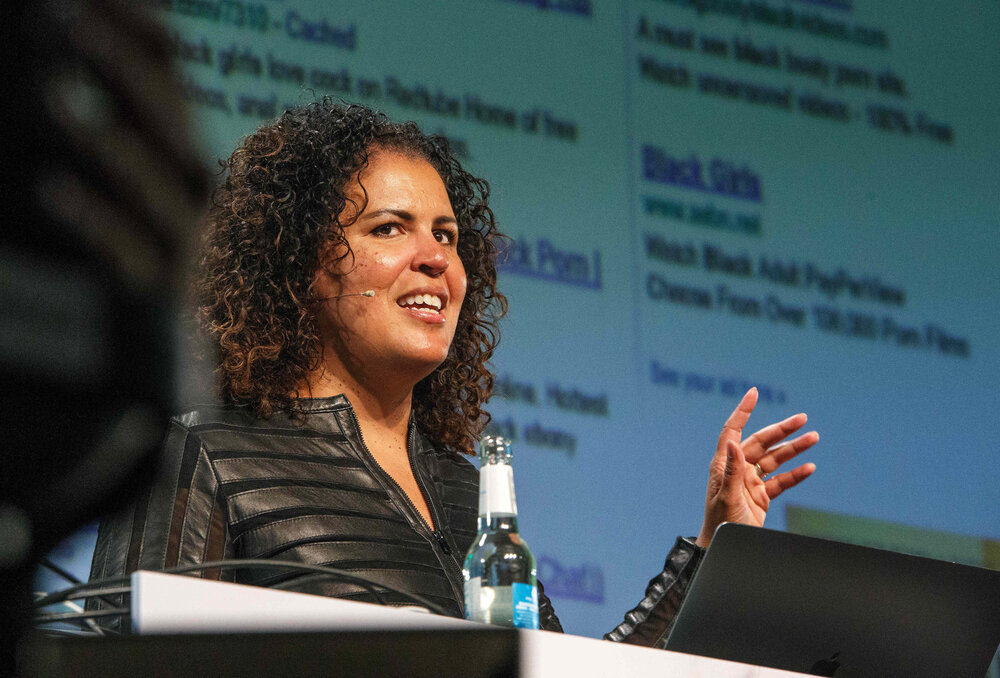
Therefore, the choice of Shoshana Zuboff as the leading intellectual critic of these new systems of organisation captures this lack of ‘outsider’ thinking. Although an academic that provides a prescient warning for modern society, the author of The Age of Surveillance Capitalism describes such a system as a ‘rogue capitalism’. In her eyes, Apple and a pre-Alexa Amazon are ideal forms of ‘advocacy capitalism’.
The implication of this is that prior to Google discovering the recipe for ‘behavioural surplus’ (the ability to extract behavioural data that is more valuable than the returns to improved services that you get), political conditions and institutions were fine and dandy. The Social Dilemma ignores the economic and historical conditions that have driven political change in the past 40 years.
It should then be no wonder that Zuboff is the go-to critic for a political class that is struggling to come to terms with why they are no longer winning elections. Tech blogger and thinker Cory Doctorow provided a scintillating review of this mindset in his long read titled ‘How to destroy surveillance capitalism’, where he argues that much of the A/B testing, microtargeting and psychometric profiling carried out by many of these companies is merely snake oil. In this sense, we are all foolishly buying into their hype that these products are effectively ‘mind control rays’.
According to this constituency of people, rather than an increasingly commodified economy, mysterious Russian bots are to blame for the rise of populism. Within this schema, instead of looking to a history of inequality, it is Google that is destroying democracy. Choosing to see their creations as the driving force of the world simply reflects the same complacency that culminated in their projects going haywire in the first place.
Thus, viewers of The Social Dilemma will search in vain for explanations of algorithmic bias, the relationship of tech to the military-industrial complex, monopoly capitalism, and platform capitalism in order to understand the framing of today’s problems. These are all fundamental socio-historical issues that could explain the exercise of power and control in a manner that we can barely comprehend. Yet, these explanations never arrive. Maybe they will get there after The Social Dilemma 5 or 6.
Even more dismaying is the lack of solutions on offer by the executives, who all still have plum jobs despite their claims to have helped destroy our modern social fabric. It is welcome to see a suggestion that behavioural data should no longer underpin their business model, but no alternative is proposed. Nobody on the show even suggests concepts such as breaking up or democratising the companies, or particular regulation and tax changes.
Tristan Harris, an ex-Google exec, who you could describe as the main character in the film, clearly sees himself as embarking on a Jamie Lannister-style character arc. He confidently asserts: ‘We built these things, and we have a responsibility to change it’. It is clear that Tristan and his fellow executives can offer insights on how to stave off further disaster, but I’m sure he will forgive us if we take what Google’s former “Design Ethicist” said in context of the previous mistakes that he has made.
Are the people who built these destructive machines the best people to fix them? Imagine if the traders who created mortgage-backed securities started throwing their hat in the ring to be fronting the Financial Conduct Authority and other vital checks and balances to our financial system. Although learning from mistakes is essential, a broader canon of thought is necessary to correct these problems.
The Social Dilemma will undoubtedly shock viewers into realising we cannot continue with this current model. In this sense, it may represent a powerful call to action. However, the film missed the target on a number of occasions, failing to illuminate to audiences many of the underlying structural conditions that have caused the problems Orlowski has discussed. The residue of technological determinism, the notion that it is technology as the primary actor driving history, lingers on a film that gives much of the Silicon Valley sphere a free ride.